| | Forum for Climate and Global Change (ProClim)
Newsletter on climate and energy No 0501.06.26 | |
|
|
|
| | Sol Kislig, Scientific associate at ProClim | | | |
|
| | | Hello , My first encounter with the topic of ‘sustainable investing’ was when I had to choose a fund for my 3a pillar retirement savings account. Finding my way through the jungle of different packages and offers, understanding which holdings (i.e. companies) are held in a fund, and assessing to what extent they can maintain the difficult balance between investment security and green, innovative investments – I found this a challenging task even for my modest investment sums. The considerations that large companies or even entire states have to make when taking financial decisions are correspondingly more complex and far-reaching. Ensuring that capital is invested as climate-friendly as possible and does not support companies or business models that drive climate change is one thing. Equally important, however, is the active financing of climate protection measures – such as those aimed at reducing emissions, adapting to climate change, or rebuilding and compensating for losses and damages caused by climate change. You can read about the various perspectives emerging from scientific research on climate finance and the levers available to Switzerland and its financial centre to drive forward national and international climate finance in the latest issue of ProClim Flash (articles available in German and French). I hope you gain many valuable insights from reading it! | |
 |
|
|
|
|
|
| | Flash #82: Climate FinanceAs in so many areas of politics, the question of funding is becoming increasingly prominent in climate policy too. We have only just voted on the Climate Fund Initiative, and already the Financial Centre Initiative is being tabled. But when we talk about climate finance, not everyone means the same thing. The breadth of the term also makes it correspondingly difficult to grasp. That is why it is high time we took a closer look and examined this topic from various angles in the new issue of Flash. Read it here now! (Available in German and French)
| |
|
|
|
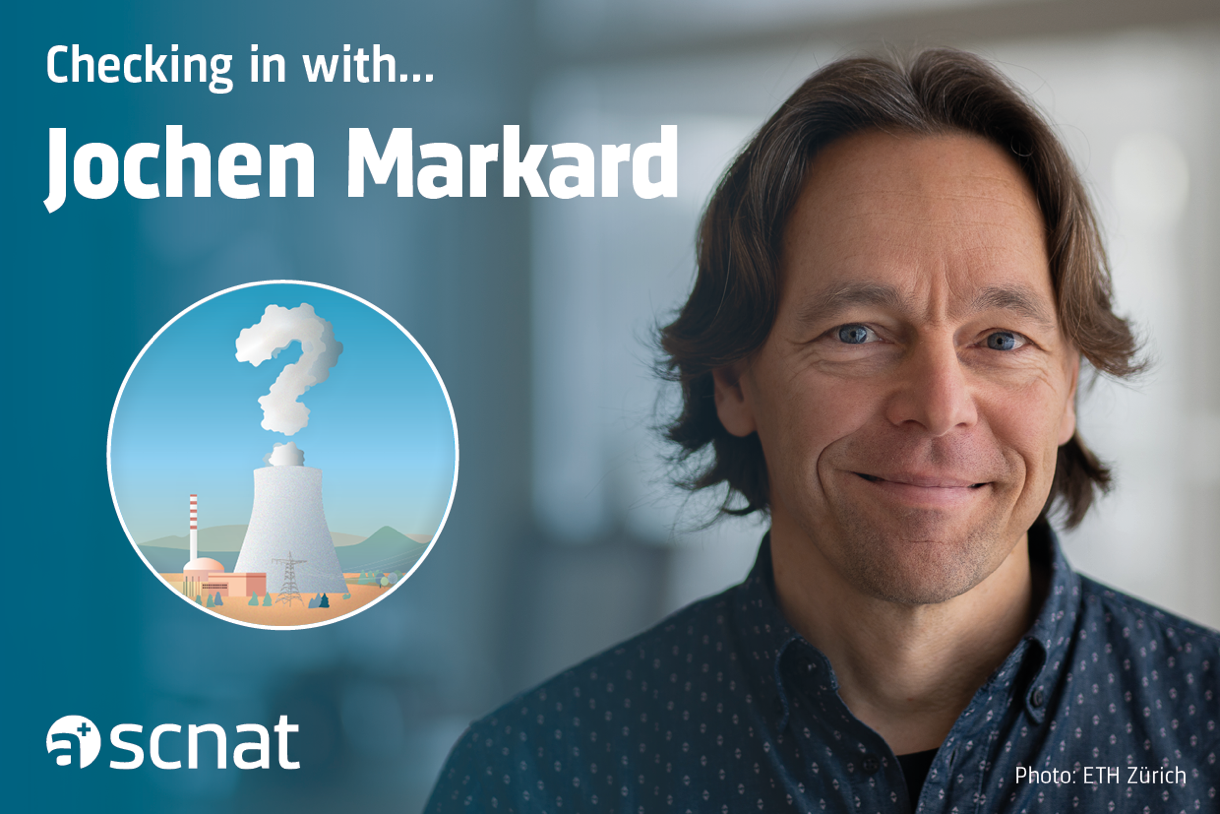
| | Checking in with… Jochen Markard: What factors influence the construction of new nuclear power stations in Switzerland?During its spring session, the Council of States voted in favour of the indirect counter-proposal to the Blackout Initiative. The construction of new nuclear power stations is to be permitted once again in Switzerland. Jochen Markard is co-author of the report “Prospects for Nuclear Energy in Switzerland” and provides an overview of the latest findings and developments in the field of nuclear energy. Find out more | | | |
| | 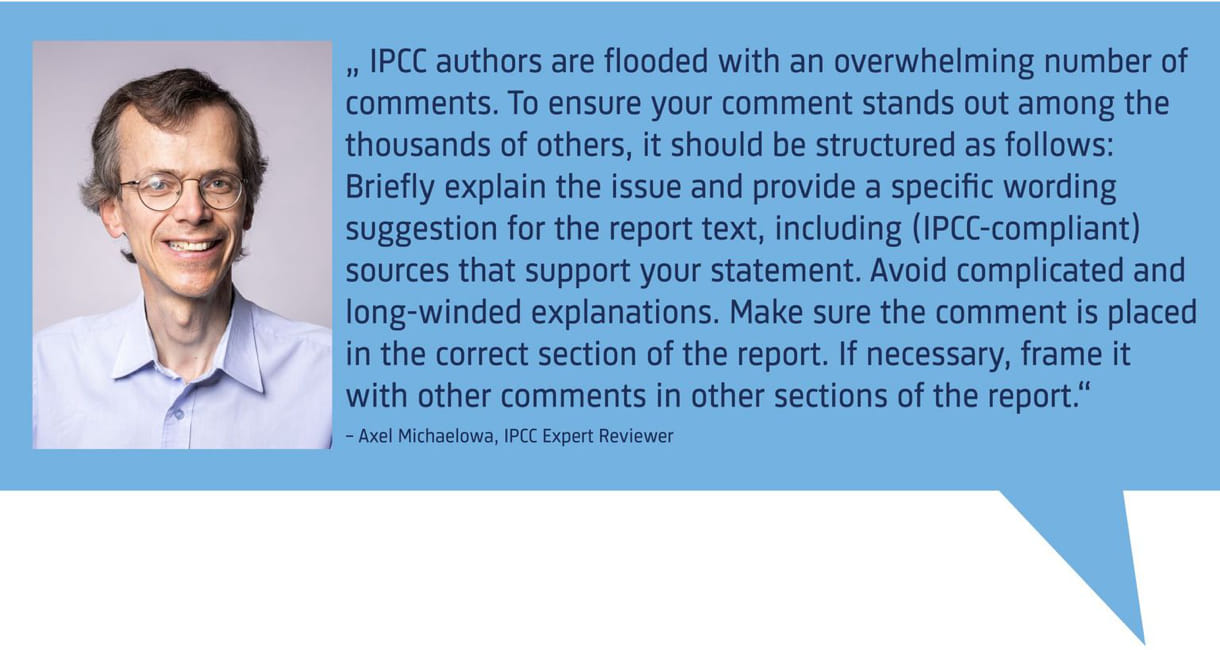 | | | |
| | Inside the IPCC Cities Report: Become part of the Review
The IPCC is currently looking for experts to review the IPCC Special Report on Climate Change and Cities, which will be published next spring. Maybe, you could be a reviewer, too: anyone with the relevant expertise can register, no matter whether you are an academic, government member, city administrator, or NGO worker. Never fully understood the IPCC process ? Unsure how to participate ? Or simply curious what this new report will be all about ? Find out more here | |
|
|
|
| |
The goal of Swiss climate policy is clear: net-zero CO₂ emissions by 2050. However, it is not yet clear how to get there. It is unlikely that the target set can be achieved using existing green technologies, increased recycling and changes in society’s behaviour alone. What is needed are new green technologies that no longer emit CO₂, whether in electricity generation, the transport sector or the heating of buildings. Read more in this Flash article (available in German and French).
| |
|
| |
|
|
|
| | NCCS-Impacts: Initial findings on heat and health
| |
| | Hot days and heatwaves are becoming increasingly common in Switzerland. High temperatures can have a detrimental effect on human health. As part of the NCCS Impacts project «Human and Animal Health», research was carried out to investigate how rising temperatures affect health and which population groups are particularly vulnerable. The findings and outputs provide a basis for decision-making for stakeholders in the fields of health, the environment, research and politics, enabling them to better identify particularly vulnerable population groups and protect them in a targeted manner. Find out more
| | | |
| | © Transitioning Away from Fossil Fuels | |
| | Key outcomes from first Summit on «Transitioning Away» from Fossil Fuels
| |
| | The first conference on «transitioning away» from fossil fuels held in Santa Marta, Colombia, from 24-29 April saw 57 countries – representing one-third of the world’s economy – debate practical ways to move away from coal, oil and gas.
Against a backdrop of war, a global oil crisis and worsening extreme weather events, ministers and envoys from across the world sat side-by-side in small meeting rooms to have open and frank conversations about the barriers they face in transitioning from fossil fuels to clean energy. Find out more | | | |
| | WMO: Invest in Resilience as Climate Risks Intensify
| |
| | The WMO Weather, Climate and Water Intelligence Commons (“WMO Commons”) seeks to mobilize at least 100 million US dollars over 5 years to finance global weather, climate and water monitoring, prediction, and service delivery systems. The new financing mechanism should safeguard the critical weather forecasting backbone, which underpins trillions of dollars in economic value and supports global stability. Find out more | | | |
|
| | | 09.06.2026 Trait-based ecology, climate change research and conservation: an environmental space perspective
Symposium, Birmensdorf ❯❯
| |
| | 22.-26.06.2026 8th European Agroforestry Conference 2026
Conference, Neuchâtel ❯❯
| |
| | 23.06.2026 One Health – The connection between human and animal health and the state of the environment in regulation and enforcement
Conference, Dübendorf ❯❯
| |
| | 29.-30.06.2026 Workshop: Climate Change and Animal Ethics
Workshop, Fribourg ❯❯
| |
| | 01.07.2026 Railway Capacity in the Context of Sustainability
Conference, Zürich ❯❯
| | | |
|
|
|
|
|
| | IPCC: Call for Experts to Review the Second Order Draft of the IPCC Special Report on Climate Change and Cities
| |
| | The Intergovernmental Panel on Climate Change (IPCC) is looking for experts to participate in the expert review of the Second Order Draft (SOD) of the IPCC Special Report on Climate Change and Cities. Registration is open until 26 June 2026. The expert review of the Second Order Draft will take place from 8 May to 3 July 2026. Read more here
| |
|
| |
|
|
|
| | Call: proposals for the SWEETER funding instrument | |
| | The Swiss Federal Office of Energy (SFOE), in collaboration with the Swiss Federal Office for the Environment (FOEN), is launching the first call for proposals for the SWEETER funding instrument. The theme is ‘Energy- and resource-efficient industrial processes’. The submission is possible until 30. June 2026. Read more here
| |
|
| |
|
|
|
| | Call: Environmental Research Prize 2026 Fribourg University
| |
| | The Environmental Research Prize of Fribourg University aims to promote disciplinary and interdisciplinary research in the field of environmental sciences and sustainability. The prize is awarded to young researchers whose innovative and outstanding scientific work contributes significantly to a better understanding of environmental problems and their solution. The submission for the prize 2026 is possible until 30. June 2026. Read more here
| |
|
| |
|
|
|
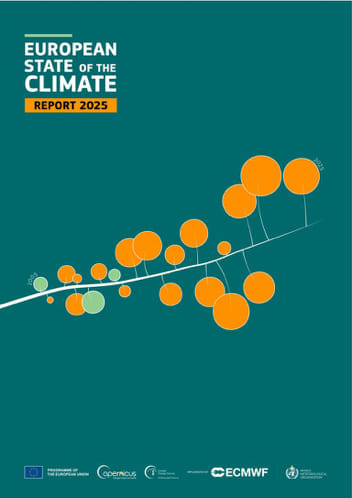
| | European State of the Climate 2025 | |
| | Rapid warming in Europe is reducing snow and ice cover, while dangerously high air temperatures, drought, heatwaves and record ocean temperatures are affecting regions from the Arctic to the Mediterranean. Europe, along with many other regions of the globe, is exposed to increasing impacts – from record heatwaves on land and at sea, to devastating wildfires, and continuing biodiversity loss – with consequences for societies and ecosystems across Europe. The report brings together the work of around 100 scientific contributors and provides a comprehensive overview of key changes in climate indicators for the world’s fastest warming continent, including cold environments, marine ecosystems and wildfire risk. Read more here
| |
|
| |
|
|
|
| | Greenhouse gas emissions under different socio-economic and climate policy scenarios for Switzerland
| |
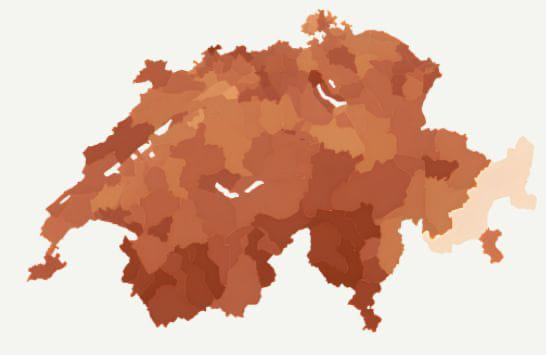
| | Scientifically based scenarios and models demonstrate how these emissions could evolve – and be reduced – under various social, economic and political circumstances. Exploratory socio-economic and climate policy scenarios are used to evaluate and compare potential outcomes. The future cannot be predicted with certainty, and uncertainty increases with the length of the time horizon and the complexity of the system. However, considering ‘if-then’ scenarios enables policy decisions to be better aligned with different possible futures. Read more here
| |
|
| |
|
|
|
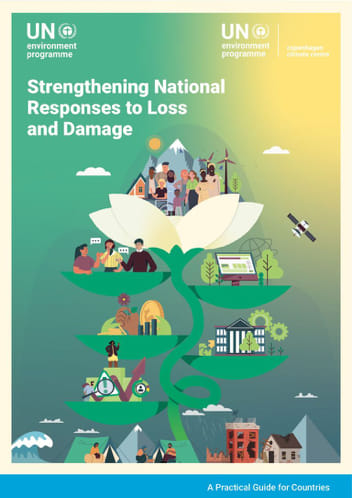
| | Strengthening National Responses to Loss and Damage
| |
| | This guideline provides a high-level, practice-informed resource for countries seeking to strengthen national responses to loss and damage. It synthesizes current concepts, evidence, policy debates, and emerging good practices, and offers an overarching framework to support reflection on, scoping, and refinement of national loss and damage strategies and related processes. Rather than prescribing a single blueprint or detailed step-by-step procedures, it highlights key issues, choices, and illustrative options that policymakers and practitioners can adapt to their own institutional, socio-economic, and environmental contexts. Read more here
| |
|
| |
|
|
|
| | Global Methane Tracker 2026
| |
| | Around the world, many countries have made reductions in methane emissions a policy priority as part of their efforts to limit near-term global warming, enhance energy security, and improve air quality. The energy sector – including oil, natural gas, coal and bioenergy – accounts for around 40% of methane emissions from human activity and has some of the best opportunities to cut these emissions. The annually updated Global Methane Tracker provides essential data on methane emissions across the energy sector and the opportunities to bring them down. Read more here
| |
|
| |
|
|
|
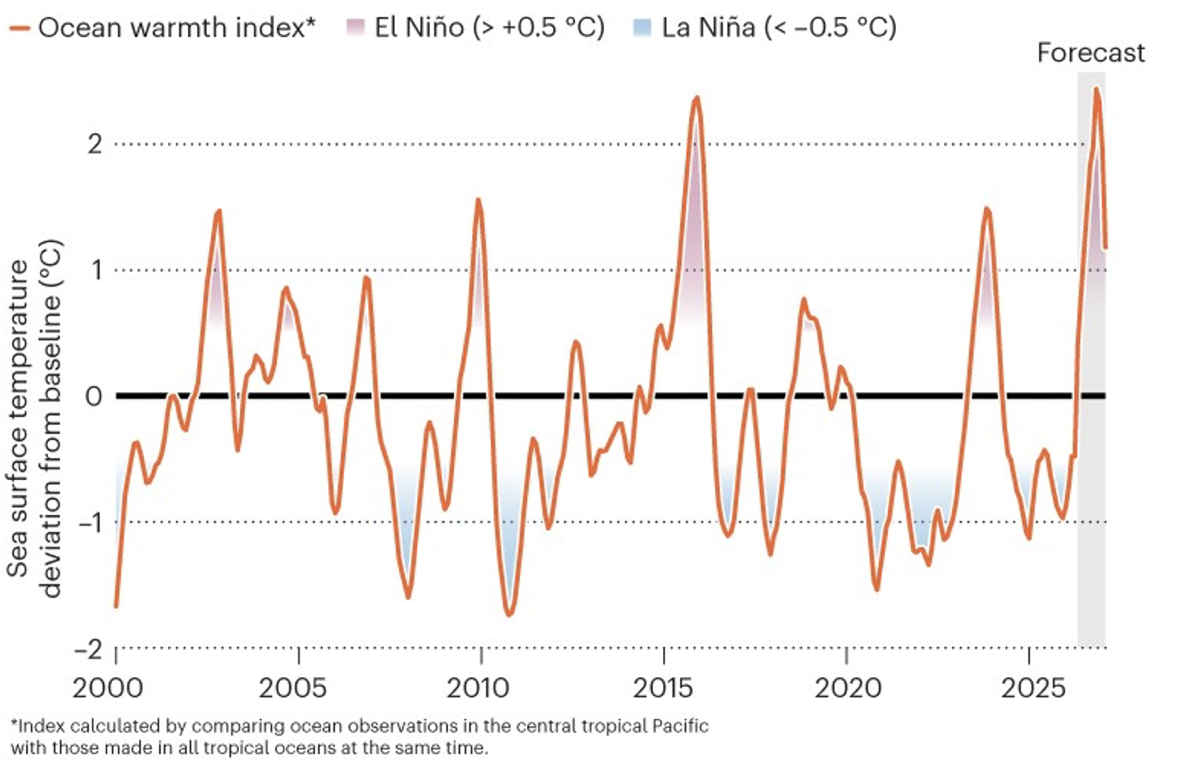
| | Fig. Meterologists are forecasting that a ‚super‘ El Niño might begin this year, with temperatures in the tropical Pacific Ocean rising by at least 2 °C above average. Models are predicting a rise of between 2.4 °C and 3.1 °C. El Niño weather patterns occur around every two to seven years, and La Niñas, when sea surface temperatures dip, occur in between. | | | |
| | Research impulse of the month
«Headlines have been proclaiming that one of the strongest El Niño weather patterns in recent decades might be starting up later this year. If a big one kicks in, as forecasts currently suggest, it could bring floods, droughts and other weather extremes to many parts of the globe, as well as potentially boost 2027’s temperatures to record highs. In the past few months, sea surface temperatures in parts of the tropical Pacific Ocean have warmed more than usual, which is the hallmark of an emerging El Niño. Still uncertain, however, is whether winds and other weather factors will either ratchet up that ocean heat or temper it — and therefore weaken the possibility of a strong El Niño.»
- Alexandra Witze, 2026 Read the full reasearch article here: Are we really headed for a ‘super’ El Niño? What the science says | |
|
|
|
| |
Swiss Academy of Sciences (SCNAT) Forum for Climate and Global Change (ProClim) | |
|
|
|
|